
The Isle of Dogs
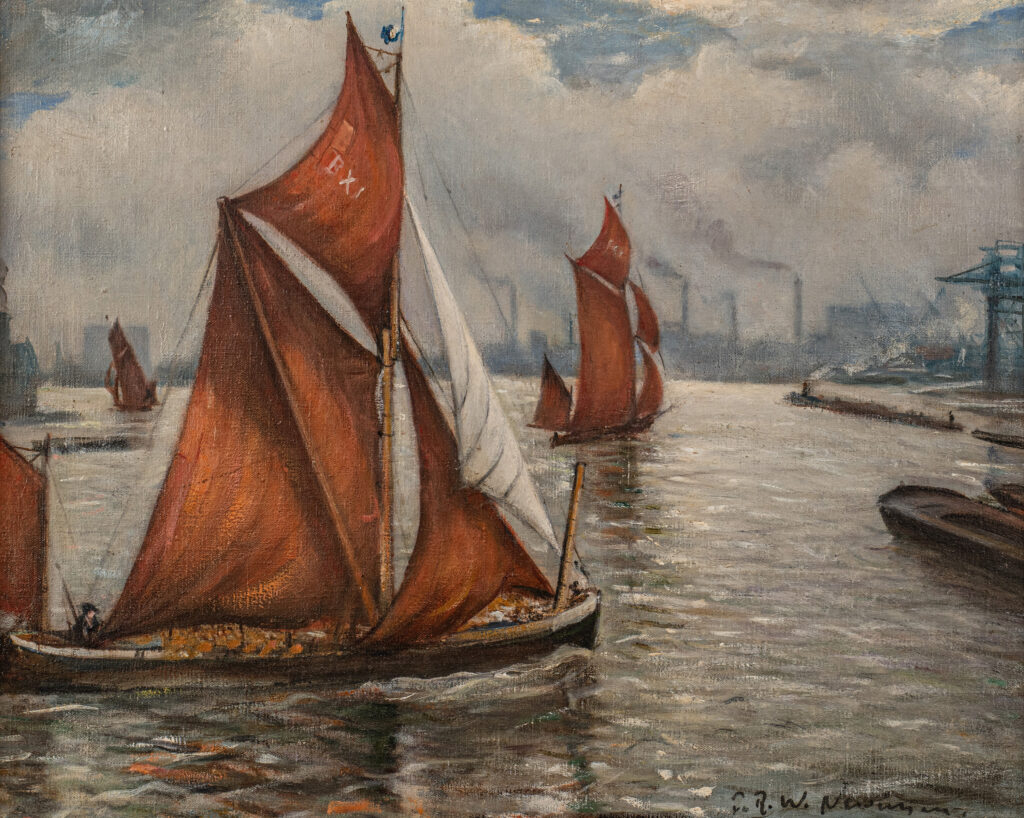

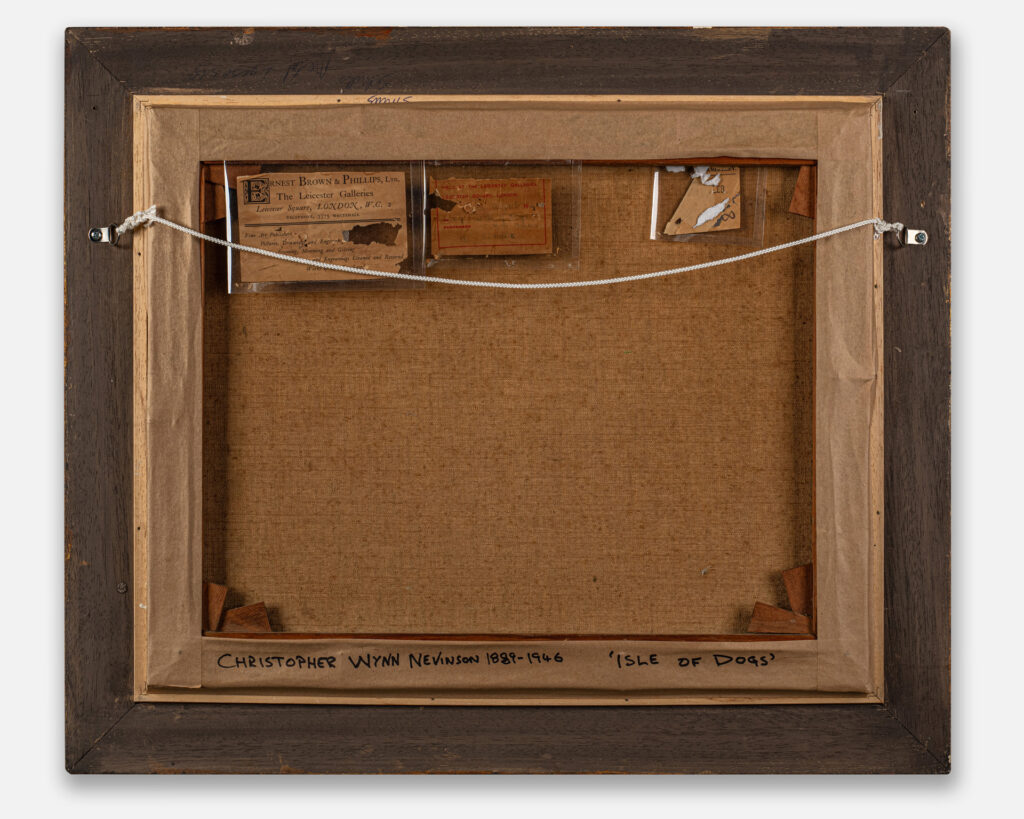


Christopher Richard Wynne Nevinson ARA
Richard Nevinson was born in Hampstead, the son of the war correspondent and journalist Henry Nevinson
and the suffrage campaigner and writer Margaret Nevinson. Educated at Uppingham School, which he
hated, Nevinson went on to study at the St John’s Wood School of Art. lnspired by seeing the work of
Augustus John, he decided to attend the Slade School of Art, part of University College, London. There his
contemporaries included Mark Gertler, Stanley Spencer, Paul Nash, Maxwell Gordon Lightfoot, Adrian
Allinson and Dora Carrington.
Gertler was, for a time, his closest friend and influence, and they formed for a short while a group known as the Neo-Primitives, being deeply influenced by the art of the early Renaissance. Gertler and Nevinson subsequently fell out when they both fell in love with Carrington. Whilst at the Slade, Nevinson was advised by the Professor of Drawing, Henry Tonks, to abandon thoughts of an artistic career. This led to a lifelong bitterness between the two, and frequent accusations by Nevinson, who had
something of a persecution complex, that Tonks was behind several imagined conspiracies against him.
After leaving the Slade, Nevinson studied at the Academie Julian in Paris throughout 1912 and 1913 and
also attended the Cercle Russe. He met Vladmir Lenin and Pablo Picasso, shared a studio with Amedeo
Modigliani and became acquainted with Cubism. While in Paris he also met the Italian Futurists Marinetti
and Gino Severini. Back in London he became friends with the radical writer and artist Wyndham Lewis.
When Wyndham Lewis founded the short-lived Rebel Art Centre, which included Edward Wadsworth and
Ezra Pound, Nevinson also joined it.
ln March 1914 he was among the founder members of the London Group. ln June 1914 he published, in several British newspapers, with Marinetti, a manifesto for English Futurism called Vital English Art.
During World War 1, Nevison volunteered firstly with the Friend’s Ambulance Unit and later with the Royal
Army Medical Corps. His first hand experience on and off the battlefield inspired a series of powerful paintings-most notably “Le Mitrailleuse’-which combined the machine aesthetics of Futurism with Cubist influences to create, stark, impactful images of Mechanised warfare. His Art from this period remains amongst the most evocative commentaries on the devastation of modern warfare.
Museums
Imperial War Museum London
Tate Gallery London